‘We are reaching a point of crisis when it comes to accessing public information’
By Marc Perrusquia
Earlier this week I had the honor of being recognized by the Tennessee Coalition for Open Government for my work in the freedom-of-information field.
I’m grateful to TCOG for dubbing me an “Open Government Champion,” a sort of lifetime achievement award for journalists. I’ve had the privilege of working with a lot of good people over the years and this wouldn’t have been possible without the help of my many colleagues at The Commercial Appeal, the Institute for Public Service Reporting and the University of Memphis.
Awards are nice. But they also provide a chance to pause and reflect, to measure the pain and pleasure of our journey — to take stock of where we are and how we got here.
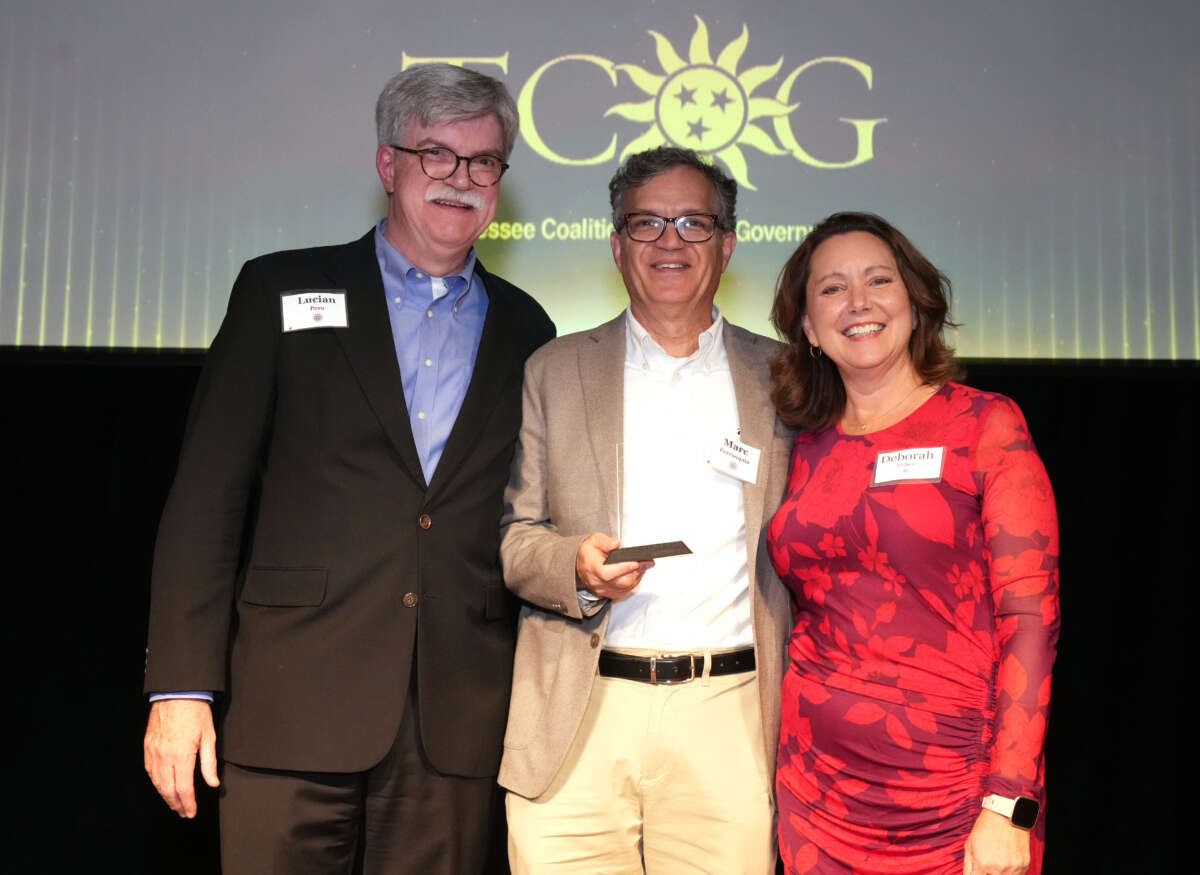
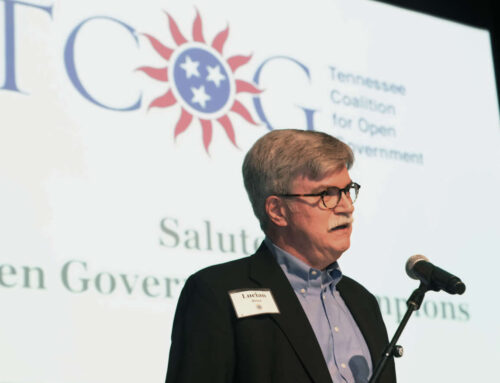
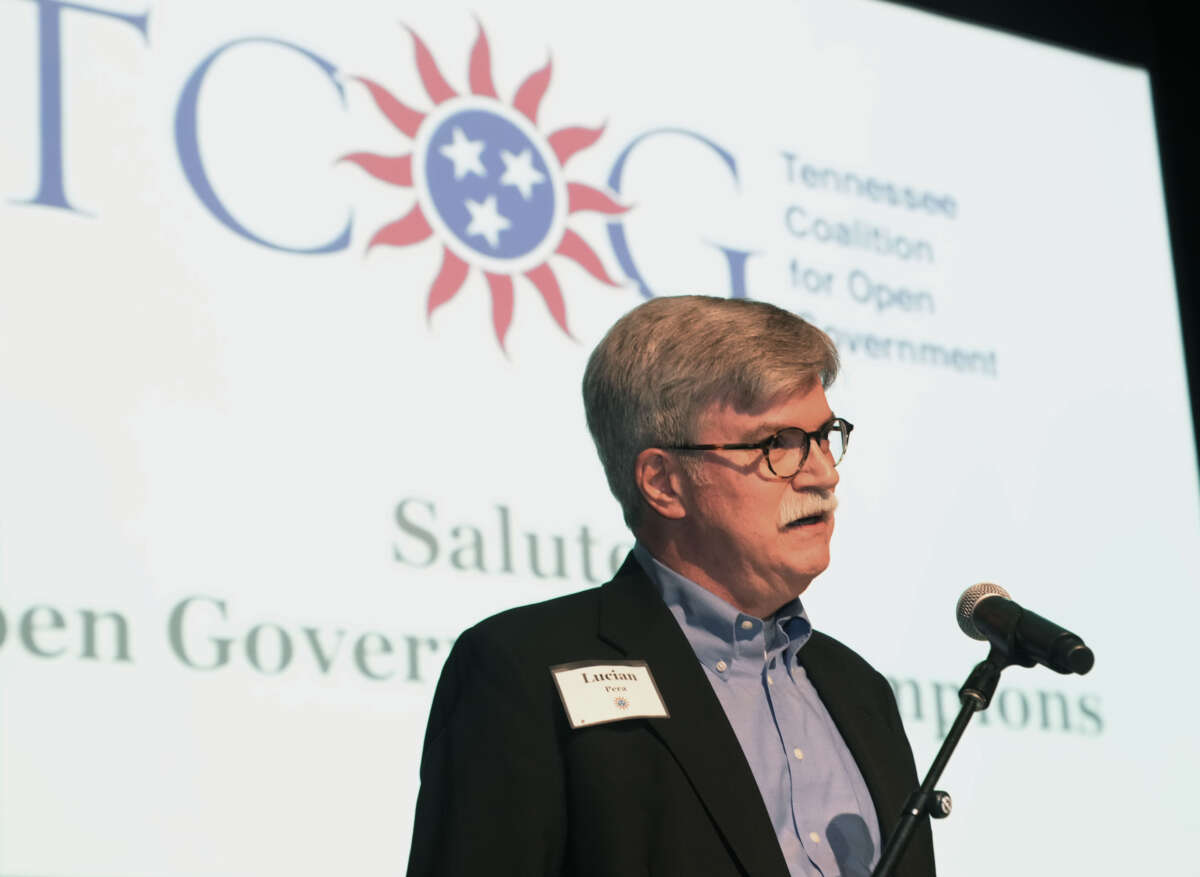
Marc Perrusquia, director of the Institute for Public Service Reporting at University of Memphis and former long-time investigative reporter for The Commercial Appeal, receives a Champion of Open Government Award from Tennessee Coalition for Open Government. Perrusquia (middle) is joined in the photo by TCOG Board President Lucian Pera and TCOG Executive Director Deborah Fisher at the TCOG’s dinner event on Oct. 22, 2025, in Nashville.
And my chief takeaway right now is this: We are reaching a point of crisis when it comes to accessing public information in Tennessee. When I started working here in 1989, Tennessee was a true records-on-demand state. I could visit practically any public agency and, more often than not, walk away with copies of public records that same day. Now, I often wait weeks, months — even years — to get records.
Sometimes, I get nothing at all. Legislators have carved out an estimated 600 exceptions to the Tennessee Public Records Act, a consequence of the oversized influence of special interests. Whole bodies of records once open to the public are now sealed.
This is not conducive to open government.
Secrecy keeps the public in the dark and it hurts our democracy.
Just as bad, many records that remain open come with steep fees and long delays that make access more theoretical than practical.
From where I sit, the motives behind these hurdles are often steeped in contempt. At times they are purely political.
Consider this: Earlier this month, state Sen. Brent Taylor emailed a public records request to the Shelby County Sheriff’s Office — after hours, at 7:21 p.m. —seeking body camera footage that appeared to contain politically damaging information about a rival. Forty-four minutes later — at 8:05 p.m. — the sheriff’s chief policy adviser Debra Fessenden responded, indicating the Sheriff’s Office would release the footage. Taylor posted the footage on Facebook the next day.
Forty-four minutes. That’s all it took — 44 minutes.
That kind of speed and ease of access has become completely foreign to me.
In fact, when I requested video footage in 2022 of a Memphis police officer beating a shackled detainee in the booking room at the Shelby County Jail, the Sheriff’s Office denied my request. I sued in Chancery Court but lost. The Sheriff’s Office fought me all the way to the Tennessee Supreme Court, which declined to hear the case, effectively siding against openness — wrongly so in the view of my public-interest-minded attorneys at the Reporters Committee for Freedom of the Press.
But all is not lost. We still have a very robust, independent news media in Tennessee. We have the Reporters Committee. We have TCOG, whose leaders have done more than anyone in the state over the past two decades to preserve access to records and promote the public’s right to know.
At the TCOG ceremony we heard some very inspiring words from Ken Paulson, director of the Free Speech Center at Middle Tennessee State University, who received the Voice of Freedom Award for his long and colorful career advocating for the public’s right to know.
I don’t have any direct quotes, but his essential message was this: The First Amendment grants us extraordinary powers. They include free speech. The right to dissent. The right to a free and independent press. Collectively, these amount to power — power to ensure that our government works for us. For we the people.
It may seem these rights are under attack as never before.
But, as Paulson said, if we all stick together — if we all stand up — we can preserve our cherished liberties.
Together, we can reinforce the guardrails the protect us from special interests and corruption — that protect and preserve our sacred democracy.
We can all be champions of open government.
Perrusquia is a long-time investigative reporter in Memphis, working for The Commercial Appeal for three decades before becoming director of the Institute for Public Service Reporting at the University of Memphis.
About the Author: Deborah Fisher