Judge rules Chattanooga City Council violated open meetings law with so-called informational meetings

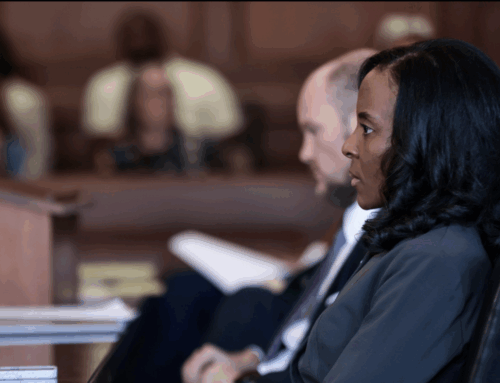
Alison Gerber, the editor of the Chattanooga Times Free Press, which brought the open meetings lawsuit, with attorneys Paul McAdoo (right) and Lin Weeks (left) of the Reporters Committee for Freedom of the Press in the Chattanooga courthouse after a hearing in the case in February 2025.
A judge’s ruling that the Chattanooga City Council and its redistricting committee violated the open meetings law in 2021 and 2022 demonstrates how far afield some cities and counties have gone in interpreting the state’s sunshine law.
The Tennessee Open Meetings Act exists to ensure that governing bodies debate public business in public, not behind closed doors. Open discussion by our representatives is important so that citizens know what led to decisions and how their representatives shaped them. Citizens have ultimate authority over their government. Essential to this authority is access to information about what their government is doing and why.
In September 2021, the Chattanooga City Council formed a redistricting committee that met three times. In March 2022, the committee brought a recommendation to the full City Council for a new voting district map. None of the committee meetings were open to the public. No minutes were taken and no public notice was given of the meetings.
As a result of those meetings, city staff produced various draft maps and, at the direction of the committee’s chair, held individual conversations with each council member to share one of the proposals, get their suggested changes and get “approval.”
By the time city staff presented a map at the March City Council meeting, it was clear that the council members had reached a consensus through non-public meetings. City staff even said this in the public meeting: “…this is the proposal based on your input… But the last word I had from every member of the council is that you were fine with this.”
The city and the redistricting committee’s chairwoman insisted that no violations of the Open Meetings Act occurred. The committee’s meetings, they said, were merely informational, in which the city staff educated them on redistricting, and no deliberations or decisions occurred. Despite city staff talking with each council member to “get approval” of a proposed map at the redistricting committee chair’s direction, they argued that city staff did not act as “conduits” to reach a consensus or a decision among council members.
Chancellor Pamela Fleenor didn’t buy these pronouncements. Instead, she looked at council members’ actions and the portrayal of the committee’s work captured in comments by council members themselves at public meetings and in email communications.
She dismissed a city attorney’s affidavit that said she did not observe any deliberations at the redistricting committee meetings, saying it failed to demonstrate that no violations of open meetings occurred. “Importantly, whether ‘deliberation,” per the (open meetings law) occurred, is a question of law for the Court to determine based on the proof.”
And the proof showed otherwise.
The judge found that from the beginning, the city council’s chairman had tasked the committee to “look at some options of what a redistricting map could look like” and “bringing us something forward for discussion so that we can begin to start the conversation of redistricting.”
The proof showed that the committee considered various models, adopted guidelines, decided that existing boundaries should be disrupted as little as possible, decided that neighborhoods should be kept intact and adopted the recommendations of city staff to follow arterial roadways and natural land features.
The judge found that such decisions and deliberations violated both the language and spirit of the open meetings act.
City staff acknowledged meeting privately with council members at the direction of the committee chair, spending an hour or two with each council member going over what changes they wanted to the proposed map.
These meetings, the judge ruled, were informal assemblages used to deliberate public business in circumvention of both the requirements and spirit of the open meetings law.
The chairwoman of the redistricting committee repeatedly insisted that no decision-making took place. “What we did is that we were educated to the process, to the existing numbers and then each councilperson met individually with the (city staff) team …” she said at a City Council meeting in March when the plan was finally presented.
Citizens in the audience didn’t buy it. How could the committee’s report or recommendation (it was called both) exist without some deliberation or decision-making by the committee?
The judge’s ruling in this case is a cautionary tale for all governing bodies, including their committees.
You cannot just announce that a governing body meeting is “informational” or “educational” and make the meeting exempt from the open meetings act. Unfortunately, I see this method being used increasingly across the state, often with the governing body’s attorney’s approval.
Governing bodies and their attorneys would do well to study the open meetings act, not to find ways to circumvent it, but to understand its purpose. It might be easier for a city council committee to meet in private, but it’s not what our form of government necessitates.
Even the Attorney General has offered advice on this in a 2012 opinion: “the Act recognizes that not every encounter among members of a public body will be considered a meeting but also cautions that such encounters are not to be used to circumvent the Act…”
“Whether a violation occurred would depend upon what was said and what transpired during the meeting. Thus, while case law does not lend itself to hard and fast rules because the decisions are so fact dependent, some cautious advice readily appears.”
Deliberation is weighing the pros and cons of a potential action. A governing body committee will be hard-pressed to say that their discussion was not weighing the pros and cons of an action and that no decisions were made, even without a vote.
As this case demonstrates, labeling a meeting as “informational” only does not make it so.
Fleenor also examined the one-on-one meetings between city staff and individual council members to come up with the proposed map. In explaining the harm caused by these serial meetings, Fleenor said this:
“The Open Meetings Act is designed to prohibit the evil of closed-door operation of government without permitting public scrutiny and participation. Here the Plaintiff established that the public was not allowed to go beyond and behind the decisions reached and be appraised on the pros and cons involved in any of the Councilmembers decisions regarding their districts in their private meetings with City Staff that led to changes in the maps.”
The Chattanooga Times Free Press, which brought the lawsuit, did not seek to undo the final decisions made on the redistricting map, but rather to ensure that the Chattanooga City Council followed the open meetings law going forward.
Fleenor granted that relief, enjoining the City Council from further violating the open meetings act and ordering it to report semi-annually in writing regarding compliance with the law.
Deborah Fisher is executive director of Tennessee Coalition for Open Government.
About the Author: Deborah Fisher